

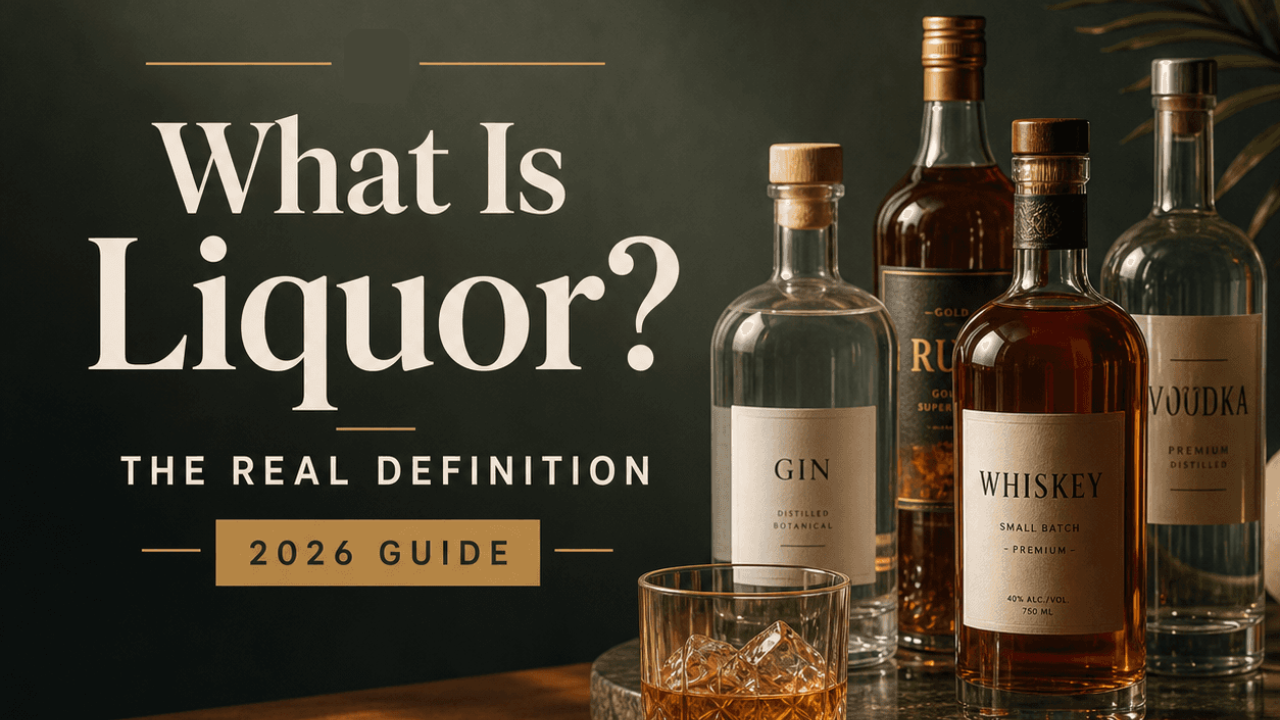

People weirdly use the word liquor. Sometimes they mean any alcohol. Sometimes they mean the “hard stuff.” Sometimes they mean, like, a bottle of tequila specifically. And then you’ve got older definitions where “liquor” basically meant any liquid at all. So if you’ve ever paused and thought… wait, what exactly counts as liquor, and what doesn’t? This is the guide. Not a stiff dictionary definition and done. The real definition of What Is Liquor, how it’s used today, how it’s used legally, how it’s used in bars, and where it gets confusing.
The simplest definition of “What Is Liquor”(how most people mean it)
In modern everyday English, liquor usually means distilled alcohol. So, alcohol made by distillation, not just fermentation.
That means liquor is typically things like:
- Vodka
- Whiskey (bourbon, rye, Scotch, etc.)
- Rum
- Gin
- Tequila and mezcal
- Brandy and cognac
- Liqueurs (yes, these too, but they’re sweetened and flavored, we’ll get there)
And it usually does not mean beer, cider, hard seltzer, or wine, even though those are alcoholic. If someone says “Do you have liquor?” they almost always mean “Do you have spirits?” not “Do you have a six pack?”
The precise definition (the one that clears up the arguments)
Here’s the clean, technical way to think about it:
- Liquor = distilled beverage alcohol (spirits)
- Beer, wine, cider = fermented beverages
- Distilled starts with something fermented, then gets concentrated via distillation
That’s it. That’s the core separation. Fermentation makes alcohol. Distillation concentrates it.
Quick example
- Grapes ferment into wine (usually around 11% to 15% ABV).
- That wine can be distilled into brandy, like pear brandy, which is often around 35% to 50% ABV.
- The brandy is liquor. The wine is not.
Liquor vs spirits (are they the same?)
Most of the time, yes. In the U.S. especially, “liquor” and “spirits” are used interchangeably to mean distilled alcohol.
If you want to be extra precise:
- Spirits is the cleaner industry term.
- Liquor is more casual, and sometimes broader depending on context.
Bars often say “spirits” on menus. Normal conversation says “liquor store.” But functionally in 2026, if someone says “spirits,” they mean liquor, and if they say “liquor,” they mean spirits.
Liquor vs liqueur (this one actually matters)
These two words get mixed up constantly, and the difference is not just spelling.
Liquor
A broad category. Distilled alcohol in general.
Liqueur
A specific type of liquor: sweetened, flavored spirits. For instance, a homemade pear liqueur could be made using brandy as a base.
Liqueurs usually have added sugar and flavorings like herbs, fruit, spices, cream, coffee, etc.
Examples of liqueurs:
- Triple sec, Cointreau
- Kahlúa
- Baileys
- Amaretto
- Sambuca
- Chartreuse
- Aperol (technically an aperitif liqueur)
So yes, a liqueur is liquor, but not all liquor is a liqueur.
If you’re making cocktails, this matters because liqueurs are doing a different job. Sweetness, flavor, texture. They’re not just “another alcohol.”
Is wine liquor?
No, not in the usual modern meaning. Wine is fermented, not distilled.
But here’s where the confusion comes from:
- Some people use “liquor” to mean “alcohol” in general.
- Some old legal or regional language uses “liquor” to include wine and beer.
- Some countries use different phrasing.
So if you’re asking in a bar, “Do you serve liquor?” you’re asking about spirits. If you’re asking in a formal regulatory sense, it depends.
What about fortified wine?
Things like port, sherry, and vermouth are fortified with distilled spirits (often grape brandy). They’re still considered wine products, not “liquor,” in most everyday usage. But legally and tax wise, they can fall into different categories.
Is beer liquor?
Again, not in modern everyday usage. Beer is fermented from grains (usually barley), and typically sits around 4% to 8% ABV, though it can go higher. If someone says “beer and liquor,” they’re separating beer from spirits. But, same caveat. Sometimes “liquor” is used as a broad umbrella word for alcoholic beverages.
What about hard seltzer, cider, and “malt beverages”?
These are generally not liquor either.
- Hard seltzers are usually fermented sugar or malt based beverages.
- Cider is fermented apple juice (or pear for perry).
- Malt beverages is a legal and industry category often used in labeling and distribution.
They’re alcoholic, yes. But they are not distilled spirits.
The alcohol content difference (why liquor hits different)
One reason people mentally separate liquor from beer and wine is ABV.
Typical ranges:
- Beer: ~4% to 8% ABV
- Wine: ~11% to 15% ABV
- Liquor (spirits): usually 35% to 50% ABV (70 to 100 proof in the U.S.)
- Liqueurs: all over the place, often 15% to 35% ABV, sometimes higher
So liquor tends to deliver more alcohol in less volume, which changes how people drink it, how quickly it affects you, and how it’s regulated.
A practical comparison: standard drink math (U.S.)
A “standard drink” contains about the same amount of pure alcohol:
- 12 oz beer at ~5%
- 5 oz wine at ~12%
- 1.5 oz liquor at ~40%
That’s why a shot is small. It’s meant to be roughly equivalent to a beer or a glass of wine, alcohol wise. Of course, real life isn’t always that neat. Craft beer can be 9%. Wine pours can be heavy. Cocktails can have two or three pours of liquor. So… yeah.
The real process difference: fermentation vs distillation
If you only remember one section, make it this one.
Fermentation (beer, wine, cider)
Yeast eats sugar and produces:
- Ethanol (alcohol)
- Carbon dioxide
- Flavor compounds
Fermentation naturally caps out. Yeast struggles at higher alcohol levels, so most fermented beverages land under ~15% to 20% ABV (there are exceptions, but that’s the general biological limit).
Distillation (liquor)
Distillation takes a fermented liquid and separates components based on boiling points. Ethanol boils at a lower temperature than water, so distillation allows you to concentrate alcohol and collect it. That’s how you get from a low ABV “wash” or “beer” to something like whiskey or vodka.
And then after distillation you might have:
- Aging (whiskey, rum, brandy)
- Filtration (vodka often)
- Botanical infusion or redistillation (gin)
- Dilution to bottling strength (almost everything)
- Sugar and flavors added (liqueurs)
So what counts as liquor? A clear list, with examples
Here’s a practical list of common liquor categories.
Vodka
Neutral spirit, typically distilled to a high purity and filtered, then bottled around 40% ABV.
Gin
Distilled spirit flavored with botanicals, with juniper as the core requirement in most definitions. Some gins are more citrusy, some more piney, some floral. It varies a lot now.
Whiskey (or whisky)
Distilled from grains and usually aged in wood.
Includes:
- Bourbon (corn heavy, U.S. rules)
- Rye whiskey
- Tennessee whiskey
- Scotch whisky
- Irish whiskey
- Japanese whisky
- Canadian whisky
Rum
Distilled from sugarcane products like molasses or fresh cane juice. Can be light, funky, aged, spiced. It’s a whole universe.
Tequila
Made from blue Weber agave and produced in specific regions of Mexico under strict rules.
Mezcal
Also agave based, but made from different agave varieties and usually cooked in earthen pits, giving that smoky profile (though not all mezcal is super smoky).
Brandy
Distilled from wine or fermented fruit. Cognac and Armagnac are specific types of grape brandy with regional rules in France.
Neutral grain spirit and “grain alcohol”
High proof spirits, sometimes used for infusions or lab style purposes. Everclear is the famous example in the U.S.
Flavored spirits
Vodka with flavor added. Or rum with coconut flavor, etc. These are still liquor, but they can be regulated or labeled differently.
Liqueurs
Sweetened, flavored spirits. Mentioned earlier. These are liquor too, just a subcategory.
Is “hard liquor” different from liquor?
“Hard liquor” is mostly just a phrase people use to mean distilled spirits, especially higher proof ones. There isn’t a universally fixed legal definition of “hard liquor” as separate from liquor.
In casual speech:
- Beer and wine feel “soft.”
- Spirits feel “hard.”
So people say “hard liquor.”
What is proof? (because liquor labels love it)
In the U.S., proof = 2 × ABV.
So:
- 40% ABV = 80 proof
- 50% ABV = 100 proof
- 60% ABV = 120 proof
In some other countries historically, proof systems were different. But in 2026, if you’re in the U.S. and you see proof, it’s basically ABV times two.
The legal definition (why it changes depending on where you live)
Here’s the annoying truth: the legal definition of liquor depends on the jurisdiction.
Different places categorize alcohol for:
- taxation
- licensing (what a store is allowed to sell)
- distribution rules
- serving laws
- alcohol content limits
- labeling rules
So you might see language like:
- “spirituous liquor”
- “distilled spirits”
- “intoxicating liquor”
- “alcoholic liquor”
- “malt liquor” (which is not the same as distilled liquor, despite the word)
A law might use “liquor” to mean any alcoholic beverage. Or it might use it to mean only spirits. That’s why you can hear two people argue and both are right. They’re just using different definitions.
“Liquor store” vs “package store” vs “ABC store”
Names vary by region.
- A liquor store usually implies it sells spirits, often plus wine and beer.
- Some states have government run stores for spirits (ABC stores or similar systems).
- Some places restrict grocery stores to beer and wine only, so “liquor” becomes the thing you need a separate store for.
So the retail experience shapes the word.
What about “malt liquor”? Is that liquor?
“Malt liquor” is a classic confusion point. Despite the name, malt liquor is usually beer, not distilled spirits. It’s a strong lager style or malt beverage category, often higher ABV than standard beer, historically marketed in larger bottles or cans.
So:
- Malt liquor contains malted grains.
- It’s fermented, not distilled.
- It’s not liquor in the spirits sense.
It’s basically a naming and marketing artifact that stuck.
Is a cocktail “liquor”?
Not exactly. A cocktail is a mixed drink that often contains liquor, but it’s not liquor itself.
Examples:
- A margarita contains tequila (liquor) plus lime and orange liqueur.
- An old fashioned contains whiskey (liquor) plus sugar and bitters.
- A mojito contains rum (liquor) plus mint, lime, sugar, soda.
So liquor is an ingredient category. Cocktail is the finished drink.
How bartenders usually talk about liquor (real world usage)
In bars, “liquor” typically refers to the bottles behind the bar. The base spirits.
You’ll hear:
- “Call liquor” (a mid tier brand you call by name)
- “Well liquor” (the cheaper house pour)
- “Top shelf liquor” (premium brands, sometimes actually better, sometimes just more expensive)
- “Rail” (where the well bottles sit)
If a bartender asks “What liquor?” they likely mean the base spirit:
- Vodka?
- Gin?
- Rum?
- Tequila?
- Whiskey?
And then you might specify the brand.
The “real definition” in one sentence (if you want to quote it)
Liquor is an alcoholic beverage produced by distillation, typically bottled at higher alcohol strength than beer or wine. That’s the definition that matches how most people, bars, and modern guides use the word.
Why the word “liquor” is so messy historically
If you read old texts, “liquor” can mean:
- any liquid
- a medicinal tincture
- an alcoholic drink broadly
It comes from Latin roots related to liquid or fluid. So the word started broad, then narrowed in common usage.
By the time modern retail and licensing systems formed, “liquor” became associated with distilled spirits, partly because that’s the category that needed stricter controls and different taxation.
So the word evolved into what we mean now.
Common liquor myths (and what’s actually true)
Myth 1: “Liquor is stronger than wine, always.”
Usually, yes, but not always.
Some fortified wines can get into the 18% to 20% range. Some liqueurs can be 15% to 20%. But typical base spirits are around 40%. So the general idea holds, but there’s overlap.
Myth 2: “Dark liquor gets you more drunk than clear liquor.”
Not inherently.
Alcohol content and how fast you drink matters more than color. Some darker spirits have more congeners (compounds from fermentation and aging) and those may influence hangover severity for some people. But “more drunk” is about ethanol dose over time.
Myth 3: “Tequila isn’t liquor, it’s its own thing.”
Tequila is a type of liquor. Specifically, a distilled spirit made from blue agave under specific rules.
Myth 4: “Liqueur and liquor are the same.”
Liqueur is a type of liquor, but not the same thing. Liqueurs are sweetened and flavored.
Liquor categories by “base material” (a helpful way to understand it)
Another way to understand liquor is by what it starts as before distillation.
- Grains: whiskey, vodka (often), some gins
- Sugarcane: rum
- Agave: tequila, mezcal
- Grapes and other fruit: brandy, fruit brandies
- Other sugars: some neutral spirits made from sugar beets or other sources
This matters because it influences flavor even after distillation, especially if the spirit is aged or distilled with more character.
Aging: why some liquor turns brown (and some stays clear)
Clear spirits are usually either:
- not aged (vodka, most unaged rum, blanco tequila)
- aged in neutral containers (stainless steel)
- or filtered to remove color (some “cristalino” styles, though that’s its own debate)
Brown spirits are typically aged in wood:
- whiskey in charred oak barrels
- aged rum in oak
- brandy in oak
- reposado and añejo tequila in oak
The barrel adds:
- color
- vanilla and caramel notes
- tannin and spice
- oxygen interaction that rounds the spirit
That’s why aged liquor tastes “softer” to a lot of people. Not always, but often.
Where people get tripped up: “alcohol” vs “liquor”
A lot of confusion disappears if you treat these as different levels:
- Alcohol: the broad category. Includes beer, wine, spirits, and everything alcoholic.
- Liquor: usually distilled spirits (and sometimes used as a broad category in law).
- Spirit: distilled alcohol (cleaner term).
- Liqueur: sweetened, flavored spirit.
So if your friend says “I don’t drink liquor,” they might still drink beer or wine. They probably mean they don’t drink spirits.
Shopping guide: if you’re in a store, what aisle is “liquor”?
In most stores that sell everything:
- Beer section: beer, seltzers, malt beverages
- Wine section: wines, sparkling wines, boxed wines, sometimes vermouth
- Liquor/spirits section: vodka, gin, rum, whiskey, tequila, brandy, liqueurs
But again, some places combine everything under “liquor” because the store is a liquor store. So you get “beer and liquor” in the same building. Language is practical like that.
FAQs people ask in 2026 (quick, clear answers)
Q1. Is champagne liquor?
No. Champagne is sparkling wine. Fermented, not distilled.
Q2. Is sake liquor?
Typically no. Sake is brewed and fermented from rice, closer to beer in process, though it’s served like wine. For more detailed information on the differences between sake and shochu or rice vodka and sake, check out these resources.
Q3. Is soju liquor?
Soju can be tricky because there are different styles. Many modern mass market sojus are distilled or use distilled neutral spirit blended with water and flavor. In common usage, soju is often treated like a spirit. Legally, classification depends on country and labeling.
Q4. Is vermouth liquor?
Vermouth is a fortified and aromatized wine. While not considered liquor in everyday speech, it contains added spirit and sits in between categories. For more in-depth information, you can read this introduction to vermouth.
Q5. Is bitters liquor?
Bitters are alcohol-based infusions. Some are very high proof. They’re technically alcoholic, sometimes treated like a spirit product, but used in tiny amounts in cocktails. Classification depends on the product and local rules.
Q6. Is cooking wine liquor?
No. Cooking wine is wine (often salted). Not liquor.
Q7. Is “rice wine” liquor?
Usually no. Many “rice wines” are fermented beverages, not distilled. (Unless it’s a distilled rice spirit, which exists, but then it’s a spirit.)
Let’s wrap this up (the definition that actually works)
If you want the real definition, you can use it without overthinking it:
- Liquor is distilled alcohol.
- Beer and wine are fermented.
- Liqueur is a sweetened, flavored liquor.
And if you’re dealing with laws, licensing, or store rules, just remember the definition can widen or narrow depending on the wording. But in normal conversation, if someone says liquor, they mean spirits. That’s the 2026 reality of the word. Slightly messy. Very human. But now you know exactly what counts.
For further understanding of the distinctions between these types of alcoholic beverages, you might find this resource helpful.
FAQS
Q1. What exactly counts as liquor in everyday language?
In modern everyday English, liquor usually means distilled alcohol or spirits. This includes vodka, whiskey, rum, gin, tequila, brandy, and liqueurs. It typically does not include beer, cider, hard seltzer, or wine.
Q2. How is liquor different from spirits?
In most cases, ‘liquor’ and ‘spirits’ are used interchangeably to mean distilled alcoholic beverages. ‘Spirits’ is the cleaner industry term often seen on bar menus, while ‘liquor’ is more casual and commonly used in conversation.
Q3. What is the difference between liquor and liqueur?
Liquor refers broadly to distilled alcoholic beverages. Liqueur is a specific type of liquor that is sweetened and flavored with ingredients like herbs, fruits, spices, or cream. For example, Baileys and Amaretto are liqueurs.
Q4. Is wine considered liquor?
No, wine is not considered liquor in modern usage because it is a fermented beverage rather than distilled. Some old legal definitions or regional uses might include wine under ‘liquor,’ but typically wine stands separate from distilled spirits.
Q5. Is beer classified as liquor?
No, beer is not classified as liquor. Beer is a fermented beverage made from grains like barley with an alcohol content usually between 4% to 8% ABV. Liquor refers specifically to distilled alcoholic beverages with higher ABV.
Q6. Why does liquor have a stronger effect than beer or wine?
Liquor has a higher alcohol by volume (ABV), usually between 35% to 50%, because it is distilled, which concentrates the alcohol. In contrast, beer generally ranges from 4% to 8% ABV and wine from about 11% to 15% ABV due to fermentation only.