

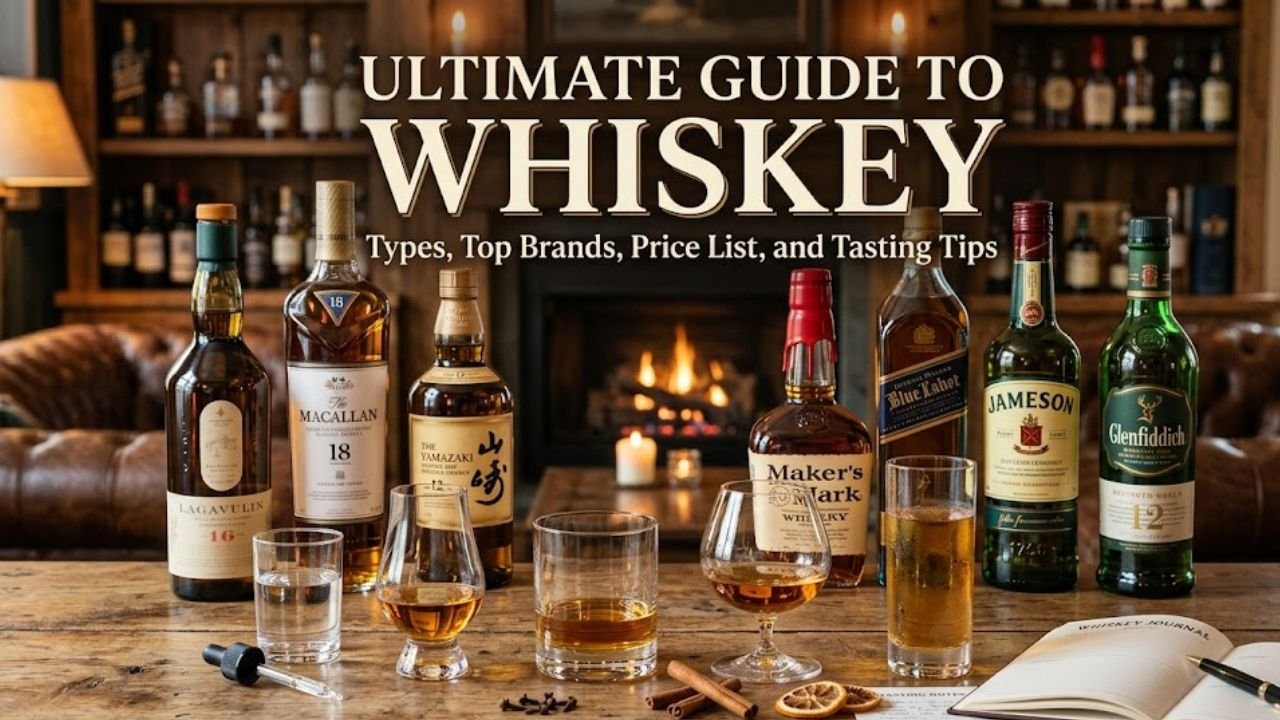

Over the past few years, I have observed one thing very closely—whenever friends gather for a get-together, or when people reunite after a long time, the name of one drink invariably comes to everyone’s mind first: Whiskey. But for me—and perhaps for many of you—whiskey is not merely a liquid poured into a glass. It is a passion, a unique source of solace, and behind every bottle lies a story of its own.
I remember the first time I took a sip of whiskey; I found it incredibly sharp and bitter. I simply couldn’t fathom why people were so obsessed with it! However, as I read more about it, tasted various brands, and began to grasp its complexity, I realized that it possesses a certain magic. When you uncork a bottle and are greeted by the aroma of wood (oak) and sweet vanilla, or when you encounter that distinct, aged, smoky flavor in a Scotch, you truly understand the immense dedication and soul the distillers have poured into crafting it.
What is Whiskey? (An Introduction to the World of Whiskey)
When it comes to a drink that embodies a perfect blend of sophistication, rich history, and deep flavors, the very first name that comes to mind is Whiskey. Across the globe, people view it not merely as an alcoholic beverage, but rather as an experience and a status symbol. Some appreciate its smoky flavor, while others are drawn to its smooth and sweet profile. But have you ever wondered how this drink—which eventually finds its way into your glass—is actually made, how many varieties exist, and why it commands such immense popularity?
Simply put, whiskey is a distilled alcoholic beverage produced from a fermented grain mash. This grain mash utilizes a variety of grains, such as barley, corn, rye, and wheat. After fermentation, these grains are distilled and subsequently aged—often for years—in wooden barrels (typically oak casks). It is this very aging process that imparts to whiskey its signature golden hue, rich aroma, and complex flavor profile.
Whiskey vs Whiskey: The real challenge of spelling
If you have ever paid attention, you may have noticed that some bottles in the market are labeled “Whisky,” while others read “Whiskey” (with an ‘e’). Many people mistake this for a simple typing error or a spelling mistake; however, there is a distinct geographical and historical reason behind it:
- Whisky (Without an ‘E’): This spelling is used for spirits produced in countries such as Scotland, Canada, Japan, and India—for instance, Scotch Whisky or Japanese Whisky.
- Whiskey (With an ‘E’): This spelling is used for spirits manufactured in countries like Ireland and the United States (USA)—such as Irish Whiskey or American Bourbon Whiskey.
To help remember this distinction, people often cite a simple marketing rule: If the name of the country contains the letter “E” (e.g., United States, Ireland), then the spelling of the spirit will also include an “E.” Conversely, if the country’s name does not contain an “E” (e.g., Scotland, Canada, Japan), then the spelling of the spirit will likewise omit the “E.”
It’s Craze at the Global Level and in India
The passion for whiskey is global, yet you might be surprised to learn that India is the world’s largest consumer of whiskey. In terms of volume, the amount of whiskey consumed in the Indian market surpasses that of any other region in the world. However, while people in India previously preferred only affordable blended whiskeys, the trend has now shifted completely. Today’s generation is rapidly gravitating toward premium brands, Single Malts, and craft whiskeys.
Whether you are a beginner attempting to choose your first bottle, or a whiskey connoisseur seeking in-depth knowledge about premium single malts—this comprehensive guide will introduce you to every aspect of whiskey that you need to know.
The History of Whiskey: Where Did This Obsession Begin?
The history of whiskey is nothing short of a cinematic tale. The refined and premium drink we enjoy in our glasses today was not always this way. Initially, it was used as a medicine; its journey—from those humble beginnings to becoming a luxury lifestyle statement today—spans centuries.
The word “whiskey” is actually derived from the Gaelic terms “Uisce Beatha” (Irish) or “Uisge Beatha” (Scottish), both of which translate to “Water of Life.” In ancient times, when people observed that consuming this liquid generated warmth in the body and provided relief from pain, they came to regard it as the very “water of life.”
Origins: The Contribution of Ireland and Scotland
To whom does the true credit for the invention of whiskey belong—Ireland or Scotland? This is a debate that has persisted for centuries, with both nations laying claim to the distinction.
- Ireland’s Claim: Historians believe that the art of distillation (the process of purifying alcohol through vaporization) was first mastered by monks in the Mediterranean region. Sometime between 1000 and 1200 AD, Irish monks brought this technique to Ireland. Since grapes did not grow easily in that climate, they began fermenting and distilling local grains—specifically barley—instead of grape wine. And thus, the first primitive form of whiskey was created.
- Scotland’s Written Record: Although Ireland may be ahead in its historical claims, Scotland possesses the earliest official written record of whiskey. An Exchequer Roll (a government tax record) dating back to 1494 has been discovered; it mentions the allocation of approximately 500 kilograms of malted barley to a monk named Friar John Cor, under royal command, for the production of “Aqua Vitae” (the Water of Life).
Initially, this spirit was quite harsh and fiery, as it was not yet subjected to maturation or aging in barrels. People would consume it immediately after it was drawn from the distillery.
The Industrial Revolution and Modern Distilling Techniques
With the advent of the Industrial Revolution in the 18th and 19th centuries, the whiskey industry underwent a complete transformation. Two primary factors drove this change:
- Taxation and Smuggling: The British government imposed such heavy taxes on whiskey that local distillers in Scotland and Ireland began producing it illegally—in secret, hidden within the hills and caves. These individuals came to be known as “Moonshiners.” This illicit smuggling activity led to a sudden and significant surge in the demand for whiskey.
- The Invention of the Column Still (1831): Previously, whiskey was produced exclusively using traditional “Pot Stills,” a labor-intensive process that yielded relatively small quantities. However, in 1831, an Irish inventor named Aeneas Coffey invented the “Column Still” (also known as the Coffey Still). This apparatus enabled continuous distillation, paving the way for the large-scale, cost-effective production of grain whiskey that was far smoother than anything produced before. It was in the wake of this innovation that “Blended Whiskey” was born—a product that would eventually come to dominate markets across the globe.
The Evolution of Whiskey in India (From the British Era to Homegrown Brands)
The arrival of whiskey in India—and its subsequent transformation into the country’s largest market—constitutes a truly fascinating chapter in history:
The British Arrival: The trend of whiskey consumption in India began with the British. In the 19th century, when the British Army and colonial officials arrived in India, they began to keenly feel the absence of their beloved Scotch Whisky. Importing it from England, however, proved to be prohibitively expensive.
India’s First Distillery (1820s): To resolve this predicament, a British businessman named Edward Dyer established India’s very first distillery in Kasauli, Himachal Pradesh, during the late 1820s (a venture that later evolved into Mohan Meakin). Kasauli’s climate and water supply were remarkably similar—and just as cool—as those of Scotland; consequently, the production of high-quality, yet affordable, whiskey began there.
The Journey from Molasses to Grain: Following India’s independence, local manufacturers began producing alcohol using molasses—the waste product derived from sugarcane. This category of spirits came to be known as ‘IMFL’ (Indian Made Foreign Liquor). Brands such as McDowell’s No.1, Royal Stag, and Bagpiper subsequently came to dominate the entire domestic market.
The Global Rise of Indian Single Malts: Contemporary India is no longer a consumer solely of affordable whiskey. Over the past few years, Indian Single Malts—such as Amrut, Paul John, Rampur, and Indri—have won prestigious global awards, thereby surpassing even the most renowned brands from Scotland. India’s warm climate causes whiskey to mature three times faster than it does in Scotland; this accelerated maturation process imparts a unique, rich, and fruity flavor profile to Indian whiskey—a profile that is now being acclaimed across the entire world.
Different Types of Whiskey (Understanding the Varieties)
While the basic process of making whiskey may appear similar across the globe, the selection of grains, distillation methods, local climate, and aging duration make every whiskey distinctively different from the others. If you aspire to be a true whiskey connoisseur, you must have a crystal-clear understanding of the distinctions between its core types. Let’s explore this in detail.
Scotch Whisky (The Pride of Scotland)
If there is one whiskey that commands the utmost respect and premium status worldwide, it is Scotch Whisky. A whiskey can be designated as ‘Scotch’ only if it has been legally distilled in Scotland and matured in oak casks for a minimum of three years. A signature element of Scotch is its smoky flavor, which is imparted by drying the malted barley using “peat”—a type of coal-like fuel.
Scotch primarily comes in two major types:
- Single Malt Scotch: It is produced at a single distillery and utilizes only 100% malted barley. It is considered the purest and most premium variety.
- Blended Scotch: It is created by blending various single malts and grain whiskies together to achieve a consistent and smooth taste.
- Taste Profile: Smoky, savory, and earthy—featuring notes of peat, leather, and a touch of light fruit.
- Popular Brands: Glenfiddich, Johnnie Walker (Black/Red Label), Chivas Regal, Macallan, Talisker.
Bourbon Whiskey (American Classic)
Bourbon is an entirely American whiskey. Although it can be produced anywhere across the USA, 95% of its production takes place in the state of Kentucky. There are very strict rules governing the production of Bourbon:
- Its grain mash must contain at least 51% corn.
- It is aged exclusively in brand-new charred oak barrels, without the addition of any artificial colors or flavors.
Due to the corn content, Bourbon is significantly sweeter and smoother compared to other whiskies.
- Taste Profile: Sweet vanilla, caramel, oak, and a slight smoky sweetness.
- Popular Brands: Jim Beam, Jack Daniel’s (Tennessee style, which is very similar to bourbon), Maker’s Mark, Buffalo Trace.
Irish Whiskey (Smooth & Triple Distilled)
Irish whiskey, produced in Ireland, is renowned for its exceptionally smooth and approachable taste. Unlike Scotch, Irish whiskey does not utilize peat; consequently, it lacks a smoky flavor. Its most distinctive feature is that it undergoes triple distillation—a process of being refined three times—whereas most Scotches are distilled only twice. This triple distillation process eliminates any harshness, making it the perfect choice for beginners.
- Taste Profile: Light, fruity, floral, smooth vanilla, and very minimal burn/sharpness.
- Popular Brands: Jameson, Bushmills, Tullamore D.E.W.
Rye Whiskey (Spicy & Bold)
If you are looking for a whiskey that is slightly spicy and packs a strong punch, then Rye Whiskey is the one for you. While the specific regulations vary slightly between the United States and Canada, the standard rule dictates that it must contain a mash bill of at least 51% rye grain. The rye grain imparts a unique, peppery, and complex character to the whiskey, which is considered ideal for crafting cocktails—such as the Old Fashioned or the Manhattan.
- Taste Profile: Spicy, black pepper, cinnamon (dalchini), dry, and less sweet.
- Popular Brands: Bulleit Rye, Woodford Reserve Rye, Sazerac Rye.
Japanese Whisky (Art of Precision)
Japanese whisky has astonished the entire world over the past few decades. Japan learned the art of whisky-making from Scotland; consequently, its style bears a strong resemblance to Scotch. However, Japanese distillers are renowned for their precision and pursuit of perfection. They utilize a variety of unique barrels—such as Mizunara Oak (a native Japanese wood)—which imparts to the whisky a truly distinct aroma reminiscent of sandalwood and incense.
- Taste Profile: Highly refined, clean, delicate floral notes, mild smoke, aur rich spice.
- Popular Brands: Yamazaki, Hibiki, Hakushu, Nikka From The Barrel.
Indian Whiskey (The Global Volume Leaders)
The Indian whisky market is the largest and most unique in the world. In India, whisky is viewed in two distinct ways:
- IMFL (Indian Made Foreign Liquor): In India, most of the affordable whiskey sold in the mass market is not actually produced from grain, but rather from molasses (a neutral spirit derived from sugarcane syrup), to which a small amount of Scotch malt is added. In technical terms, this is not recognized as whiskey by global standards; however, it remains the most widely consumed category in India.
- Premium Indian Single Malts: This is the segment that has brought glory to India’s name on the global stage. Crafted entirely from 100% Indian six-row barley, these single malts fully adhere to international standards. India’s hot climate significantly accelerates the aging process, resulting in whiskies that possess a remarkably deep and rich flavor profile, even at a relatively young age.
- Taste Profile: (Premium Malts) Tropical fruits (mango, pineapple), rich spices, honey, and rich sweetness such as jaggery.
- Popular Brands: Amrut (Fusion), Paul John, Rampur, Indri (Trini).
From Distillery to Glass: How Is Whisky Made?
Crafting a fine whiskey is no ordinary feat; rather, it is a magnificent blend of science and art. Every whiskey—whether affordable or premium—must pass through five main stages during its production. Let’s understand this entire process step-by-step.
1. Malting & Mashing (Preparing the Grain)
First, the appropriate grains (barley, corn, rye, or wheat) are selected. If producing Scotch or Single Malt, the barley is soaked in water to allow it to sprout slightly. This process is called Malting, during which the starch within the grain is converted into sugar. Subsequently, these grains are ground and mixed with hot water in large tanks. This sweet liquid is referred to as “Wort.”
2. Fermentation (Converting Sugar into Alcohol)
Now, this warm, sweet liquid (wort) is transferred into large tanks, where yeast is added. The yeast consumes all the sugar present in the liquid, converting it into alcohol and carbon dioxide. After approximately 48 to 96 hours, the liquid begins to resemble a type of crude beer, known as “Wash.” At this stage, the alcohol content typically ranges from 7% to 10% ABV.
3. Distillation (Increasing Alcohol Purity)
Next, this “wash” is heated in large copper vessels known as Stills (either Pot Stills or Column Stills). Since alcohol has a lower boiling point than water, it vaporizes first. This vapor is then cooled and condensed back into a liquid form. Most whiskies undergo distillation two to three times to increase the alcohol content to between 60% and 70% ABV. At this stage, the liquid is completely clear—resembling water—and is referred to as “White Dog” or “New Make Spirit.” 4. Aging / Maturation (The Magic of Wood)
This clear, potent spirit is now sealed inside wooden containers—specifically Oak Barrels (Casks)—and left to rest for years. For any whiskey, 60% to 70% of its flavor, as well as its entire golden hue, is derived from this very wood. As the seasons change, the wood expands and contracts; this process allows the alcohol to penetrate deep into the wood, absorbing flavors of vanilla, caramel, and oak.
5. Blending & Bottling (The Final Touch)
After spending years inside the barrels, a Master Blender conducts taste tests on samples from various casks. They blend different batches together to ensure that the brand’s signature taste remains consistent. Subsequently, a small amount of pure water is added to the batches to bring the alcohol content to the standard 40% or 42.8% ABV; the liquid is then bottled and shipped to the market.
Popular Whiskey Price List (Indicative Market Rates)
Alcohol prices in India are not standardized. Each state (such as Delhi, Haryana, Mumbai, and Karnataka) has its own excise policy, transport fees, and local taxes, resulting in significant variations in prices.
Note: The prices listed below are average estimates (indicative market rates) and may vary slightly—either higher or lower—depending on your local state regulations.
You can select your favorite whiskey from the table below, based on your budget and preferences:
| Brand Name | Type / Category | ABV (%) | Expected Price (750ml) |
| 8PM | Blended Indian Whiskey | 42.8% | ₹450 – ₹550 |
| Imperial Blue (IB) | Blended Indian Whiskey | 42.8% | ₹600 – ₹700 |
| Royal Stag (RS) | Blended Indian Whiskey | 42.8% | ₹750 – ₹850 |
| Royal Challenge (RC) | Premium Indian Blend | 42.8% | ₹800 – ₹950 |
| Blenders Pride (BP) | Premium Indian Blend | 42.8% | ₹1,200 – ₹1,400 |
| 100 Pipers | Blended Scotch Whisky (My favorite brand) | 40% | ₹1,700 – ₹2,200 |
| Johnnie Walker Red Label | Blended Scotch Whisky | 40% | ₹1,800 – ₹2,400 |
| Teacher’s Highland Cream | Blended Scotch Whisky | 40% | ₹1,900 – ₹2,400 |
| Ballantine’s Finest | Blended Scotch Whisky | 40% | ₹2,000 – ₹2,500 |
| Jameson Irish | Triple-Distilled Irish | 40% | ₹2,400 – ₹3,200 |
| Jack Daniel’s Old No. 7 | Tennessee / American | 40% | ₹2,600 – ₹3,500 |
| Chivas Regal 12 Year | Premium Blended Scotch | 40% | ₹3,200 – ₹4,000 |
| Johnnie Walker Black Label | 12-Year Blended Scotch | 40% | ₹3,400 – ₹4,500 |
| Indri Trini | Three-Wood Indian Single Malt | 46% | ₹3,200 – ₹5,000 |
| Amrut Fusion | Indian Single Malt | 50% | ₹4,000 – ₹5,500 |
| Glenfiddich 12 Year | Single Malt Scotch Whisky | 40% | ₹5,500 – ₹7,50 |
What does the Price of Whiskey Depend on?
When you visit a liquor store, you may have noticed that one bottle of whiskey sells for ₹600, while another costs ₹6,000—or even more. Since the alcohol percentage in both is roughly the same (40%–42.8%), why is there such a massive price disparity? There are several major technical and geographical factors that determine the cost of whiskey:
1. Age Statement (Maturation Period) and “Angel’s Share”
The older whiskey gets, the more expensive it becomes (such as 12-year, 15-year, or 18-year varieties). There are two major reasons for this:
- Angel’s Share: When whiskey remains sealed in wooden barrels for years, approximately 1% to 2% of the alcohol evaporates annually. Distillers refer to this natural loss as the “Angel’s Share.” This means that if a barrel is left undisturbed for 18 years, roughly 30% to 40% of its liquid will have evaporated into the air. Due to the reduced volume of the remaining liquid, its value increases significantly.
- Storage Cost: Maintaining and looking after barrels in large warehouses for years entails significant expense.
2. Ingredients & Raw Materials (Malt vs Grain)
- Malted Barley: 100% malted barley is used to produce single malts. Cultivating, malting, and handling barley is quite expensive in terms of farming and processing.
- Corn and Wheat: Bourbon or regular blended grain whisky utilizes corn, wheat, or molasses—ingredients that are quite inexpensive and readily available in the market. Consequently, blended brands are available at a lower price point.
3. Import Duties and State Excise Taxes (India’s Tax System)
Alcohol is subject to the highest taxation in India. If you are purchasing a foreign brand (such as Scotch, Bourbon, or Irish whiskey), the government levies Customs Duty or Import Tariffs on it. Furthermore, every state in India has its own local excise policy. The tax rate in Mumbai, for instance, differs significantly from that in Delhi or Goa. This is precisely why the same bottle can be found in different states with a price variation of up to ₹1,000.
4. Cask Types & Rarity (Lakdi Ka Kharcha)
Some premium brands utilize extremely rare and expensive barrels to mature their whiskey—such as Spanish Sherry Casks, Port Wine Barrels, or Japan’s costly Mizunara Oak. The cost of these barrels is several times higher than that of standard barrels. Furthermore, if a batch is a “Limited Edition” or “Single Cask” release, the price surges suddenly due to low supply and high demand.
Frequently Asked Questions (FAQs) About Whiskey
Q1. What is the difference between whiskey and whisky?
There is no significant chemical difference between the two; it is merely a matter of geographical spelling preference. In Scotland, Canada, Japan, and India, it is spelled without the ‘E’—that is, “Whisky.” Conversely, brands produced in Ireland and the USA are spelled with the ‘E’—that is, “Whiskey.”
Q2. What does “Single Malt” mean? Does it come from a single barrel?
No, “Single Malt” does not mean “single barrel.” “Single” means that the whiskey was produced at a single distillery, and “Malt” means that it is made using 100% malted barley. A single malt bottle may contain a blend of spirits from different barrels within that same distillery.
Q3. Which is the world’s best-selling Indian whiskey?
In terms of sales volume, McDowell’s No. 1 and Officer’s Choice rank among the world’s best-selling Indian whiskies. When it comes to premium blends, Blenders Pride and Royal Stag hold the largest market share.
Q4. Does whiskey have an expiration date if the bottle is unopened?
No, whiskey does not have an expiration date, provided the bottle remains unopened (seal-packed) and is stored upright in a cool place, away from direct sunlight. Due to its high alcohol content (40%+), bacteria cannot thrive in it. Keep in mind that—unlike wine—whiskey does not continue to mature once it has been bottled; a 12-year-old Scotch will remain a 12-year-old Scotch, even if it is kept in the bottle for another 20 years.
Q5. Why does the price of whiskey vary so much across different states?
The reason for this is the State Excise Tax. In India, the sole authority to levy taxes on liquor rests with the state governments. Some states (such as Goa or Haryana) impose lower taxes on alcohol, whereas in states like Karnataka, Maharashtra, and Tamil Nadu, the excise duty is very high.
Q6. What distinguishes Bourbon from regular whiskey?
Ans: Bourbon is produced only when it contains at least 51% corn and has been aged exclusively in new, charred oak barrels. For this reason, its taste is sweeter than that of regular whiskey.
Q7. Which is the smoothest whiskey for beginners?
For beginners, Irish whiskeys (such as Jameson) are considered the best and smoothest options because they are triple-distilled and have absolutely no burning sensation. If you are on a tight budget, you can also start with Blenders Pride or 100 Pipers.
Disclaimer
The information provided in this article is strictly for informational and educational purposes only. We do not promote, endorse, or encourage the consumption or marketing of alcohol/liquor in any manner. Alcohol consumption is injurious to health.
The prices mentioned in this guide are indicative estimates and are subject to change. This data has been aggregated from various publicly available sources on Google and the official websites of state Excise Departments. Actual prices may vary depending on state government taxes, duties, and local retail outlets. Please drink responsibly and abide by your local legal drinking age laws.