

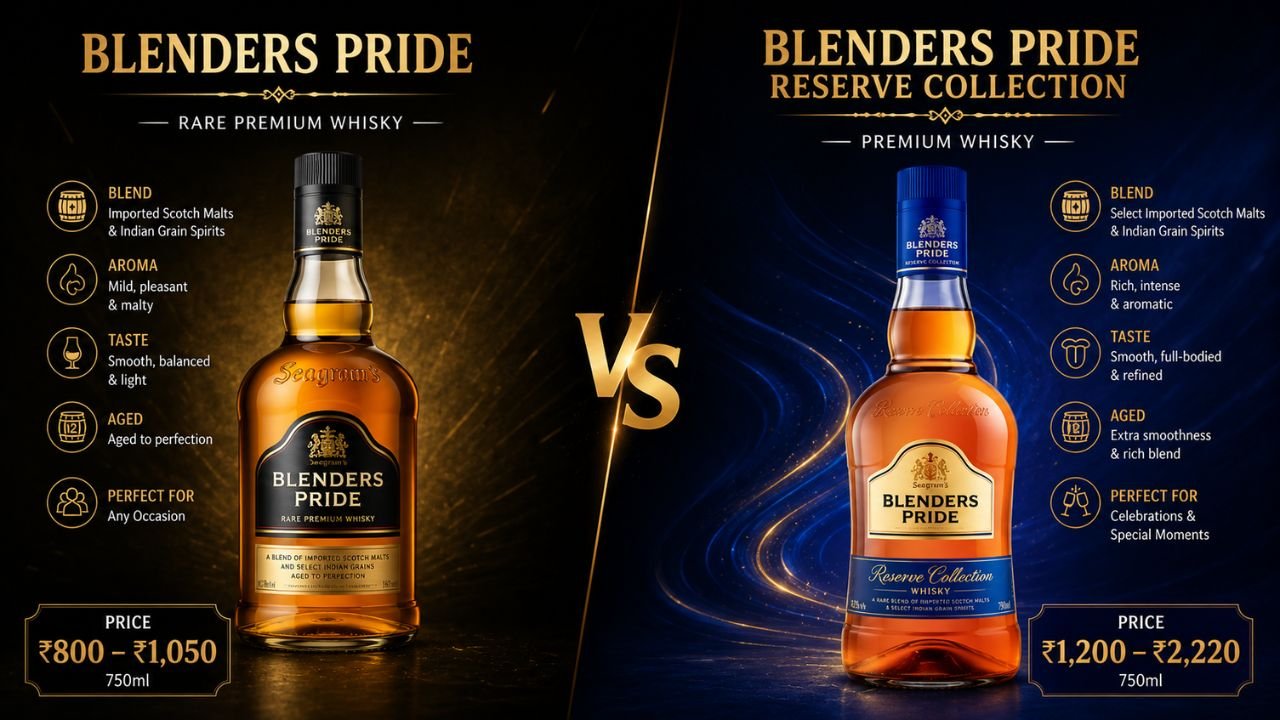

Blenders Pride vs Blenders Pride Reserve comes up constantly among whisky drinkers when they pass by two similar bottles of liquor that look alike, having gold and blue colors in a liquor store. They both bear the name Pernod Ricard, both of them have a promise of a smooth Indian whisky experience, and they are both labeled as being premium. However, the reality of what is contained in each bottle varies in a manner that will fall apart once you pour a glass.
Here, the comparison unravels precisely what distinguishes these two whiskies, how they are produced, and how much they would cost in different states. As opposed to regurgitating the dubious marketing slogans, this article examines the actual differences in production, differences in taste, and trends in prices that make the difference between the bottle that goes on your bar shelf and your pocket. By the conclusion, the decision between the two should not be a difficult choice but an informed choice after accurate investigation, as opposed to a guess due to the color of the packaging.
Blenders Pride vs Blenders Pride Reserve: Key Differences Explained
They are both whiskies of the same company and have a similar base recipe, but differ dramatically in one major production process. Standard Blenders Pride uses an imported Scotch malt mixed with Indian grain spirit in a typical batch process, whereas Blenders Pride Reserve matures its Scotch malt constituent in the Solera process, a fractional blending process borrowed from Sherry production. The difference alone is the key to almost all the differences between the two, such as the taste, price, and packaging.
Interestingly, both whiskeys have this 42.8% ABV, which means that strength is never a determining issue. What changes is complexity. Standard Blenders Pride stays light and easy, built for mixing, whereas Reserve carries a fuller body meant for slower, neat sipping. The table below clearly lays out these differences.
| Feature | Blenders Pride | Blenders Pride Reserve |
| Launch Year | 1995 | 2011 |
| Maturation Method | Standard batch blending | Solera fractional blending |
| Alcohol Strength | 42.8% ABV | 42.8% ABV |
| Malt Source | Imported Scotch malt | Imported Scotch malt, select reserve casks |
| Packaging Tone | Gold label | Blue label |
| Pack Sizes | Seven sizes, 60ml to 2L | Four sizes, 180ml to 1L |
| Best Suited For | Mixed drinks, parties | Neat sipping, gifting |
Once you understand this base distinction, the taste and pricing sections that follow will make a lot more sense.
Taste Comparison: Which One Hits Different
Flavour is where the gap between these two whiskies becomes obvious within the first sip. Standard Blenders Pride is where the vanilla and caramel sweetness start and end swiftly with slight warmth and extremely minimal aftertaste. Thanks to such simplicity, it can still be mixed with soda, cola, or water, retaining its personality.
On the other hand, Blenders Pride Reserve develops flavour in strata. The presence of dried fruit, such as apricot or plum, is noticed early, and this is followed by the sweetness of honey and a slight smoky aroma or scent that lingers long after swallowing. This is because the Solera process also allows older and more mature spirits, owing to the continuous mixing of the older with the newer batches; therefore, the flavour compounds do not start afresh with each production run.
Aroma and Palate Breakdown
- Standard Blenders Pride: leafy top notes, buttery mouthfeel, short finish
- Blenders Pride Reserve: fruity top notes, honeyed mid-palate, long warm finish
- Standard Blenders Pride works best diluted with mixers or ice
- Blenders Pride Reserve tastes best neat or with a single ice cube
ABV and Production Process Breakdown
Most consumers react to the meaning of the term “Reserve” as a more robust drink, but the same assumption does not apply in this case. The two whiskies are 42.8% ABV, equivalent to the normal level of strength found in most of the high-quality Indian whiskies in this category. The real distinction between them is not the percentage of alcohol but the production process.
Pernod Ricard sources Scotch malt for both variants from established Scottish distillers, then blends it with Indian grain spirit produced domestically. For the standard version, this blending happens through a straightforward batch method. In the case of Reserve, some of the reserve casks undergo Solera maturation, with some aged whisky always remaining in the barrel with fresh spirit being added around it. As a result, each batch of Reserve preserves flavour imprints of generations of unceasing blending, which the normal version just cannot match.
Price Difference: Blenders Pride vs Blenders Pride Reserve Across Indian States
Pricing for both whiskies changes from state to state because alcohol taxation in India runs through individual state excise departments rather than a single national rate. As a result, the same bottle can cost noticeably different amounts depending on where you’re buying it. The table below shows estimated prices across three common bottle sizes.
| State | Pride 180ml | Reserve 180ml | Pride 375ml | Reserve 375ml | Pride 750ml | Reserve 750ml |
| Delhi | ₹210–₹250 | ₹320–₹380 | ₹420–₹480 | ₹620–₹700 | ₹800–₹950 | ₹1,200–₹1,450 |
| Maharashtra | ₹200–₹260 | ₹340–₹400 | ₹410–₹500 | ₹650–₹750 | ₹780–₹1,050 | ₹1,750–₹2,220 |
| Karnataka | ₹190–₹230 | ₹300–₹360 | ₹390–₹460 | ₹580–₹680 | ₹750–₹950 | ₹1,300–₹1,600 |
| Haryana | ₹170–₹210 | ₹280–₹330 | ₹350–₹420 | ₹540–₹620 | ₹650–₹850 | ₹1,100–₹1,350 |
| Goa | ₹150–₹190 | ₹250–₹300 | ₹320–₹380 | ₹480–₹560 | ₹650–₹700 | ₹1,000–₹1,200 |
These are approximate figures and not exact, because the MRP changes due to local excise policy variations during the year. Maharashtra presents a price variation of the highest price gap on the size of 750ml, mostly due to the fact that the state levies high taxation on the super-premium drink category as compared to the standard premium category. Goa, with lower rates of excise in general, maintains lower prices of both variants of every size.
Read Our More Comparison Blogs That Help You to Choose the Right One: Johnnie Walker Black Label vs Red Label: Which One Is Actually Worth Your Money?
Bottle Sizes and Packaging
Large importance is given to packaging, as most buyers are likely conscious of it, given that it is the first indicator of the product to be in front of you on a packed shelf. The packaging of Standard Blenders Pride is gold-toned and is available in seven sizes, with the smallest being a 60ml bottle, and the largest being a 2-litre container that can be used when hosting large events. Reserve has a special blue coloured bottle and label that is only available in four sizes: 180ml, 375ml, 750ml, and 1L.
This difference in size has a practical significance as well. The fact that Reserve does not exist in smaller bottle sizes like 60ml or 90ml bottles means that first-time customers who just wish to taste the wine would have to buy no less than 180ml of the wine. Standard Blenders Pride offers more flexibility for casual buyers who want to try a small quantity before committing to a larger bottle.
How to Choose Between the Two
Your usual drinking habits should decide which bottle makes more sense for you, rather than price alone. A person who adds soda to his/her whiskey at every party does not require the stratification that Reserve does, as mixers bring this mellowing fruit and honey flavor down to the ground. Standard Blenders Pride is doing that when they do not waste money on flavour specifications that are not going to pass through.
To a person who enjoys sipping whisky on the rocks or with one ice cube, weighing substantial value to them, Reserve will provide them with a significant point of difference. The depth produced by the Solera actually tends to be valued in a quieter environment, as compared to a noisier event where the sense of taste is generally pushed into the background with talking. Gifting also levels the playing field in favor of Reserve, as its blue-packaged appearance and premium price tag feel more appropriate to a special occasion as opposed to the normal gold bottle.
Situations Where Each Whisky Works Best
- Choose standard Blenders Pride for parties, mixed drinks, and casual weekend gatherings
- Choose Reserve for neat sipping, small get-togethers, and quiet evenings
- Choose standard Blenders Pride if you’re new to Indian whisky and want an affordable starting point
- Choose Reserve for gifting during festivals, celebrations, or corporate occasions
Common Buying Mistakes to Avoid
Buyers repeatedly make the same errors when picking between these two whiskies, mostly because they compare Indian whisky labeling to international Scotch standards, which work differently altogether.
Buying Reserve, Expecting Higher Strength
Reserve is then similar in 42.8% ABV to the regular version, meaning that someone who hopes to get a more potent beverage is not disappointed. The upgrade will be solely in flavour enrichment, which does not involve alcohol.
Assuming Reserve Has an Age Statement
Indian whisky labels don’t require a printed age statement the way Scotch regulations demand. Reserve earns its premium status through the Solera process, not through a specific number of years spent in the barrel.
Ignoring Statewise Price Variations
A price difference that looks massive in Maharashtra might look modest in Goa, purely due to differing excise structures. Checking local pricing before assuming value saves unnecessary confusion at the billing counter.
Mixing Reserve With Soda or Cola
Diluting Reserve with heavy mixers wastes the fruit and honey complexity built up through years of Solera blending. Save it for neat drinking or a single ice cube instead.
Overlooking Bottle Size Availability
Reserve skips the smaller 60ml and 90ml formats altogether, so smaller towns sometimes stock only the 750ml option. Calling your local shop ahead avoids a wasted trip.
Blenders Pride vs Blenders Pride Reserve: Which Offers Better Value
Standard Blenders Pride wins clearly for regular, everyday drinking. It costs less in every state, mixes smoothly with common beverages, and delivers a consistent taste without asking much attention from the drinker. Spending extra on Reserve for daily consumption doesn’t add proportional benefit if most of your drinking involves mixers anyway.
Reserve should be a treat of the times, not a treat of a week. Similar to how you would expect to pay a bit more to order something legitimate once a week or once a month at a restaurant as opposed to drinking it nearly every day, this inherent price premium will feel fine because you are not taking it every day. The depth of flavour is much more apparent and appreciated once it is not a part of your daily life.
FAQs
Is Blenders Pride Reserve stronger than regular Blenders Pride?
No, both carry the same 42.8% ABV.
What makes Blenders Pride Reserve more expensive?
The Solera maturation process adds production time and cost.
Which whisky mixes better with soda or cola?
Standard Blenders Pride mixes better due to its lighter flavour profile.
Does Blenders Pride Reserve come in small bottle sizes?
No, the smallest available size is 180ml.
Can beginners start with Blenders Pride Reserve directly?
Starting with standard Blenders Pride works better for first-time drinkers.
Why does the price differ across Indian states?
State excise duty rates vary, changing the final retail price.
Is Blenders Pride Reserve considered a Scotch whisky?
No, it remains classified as an Indian whisky.
What does the Solera process actually do?
It blends aged and fresh spirit continuously for deeper flavour.
Which bottle suits gifting better?
Blenders Pride Reserve suits gifting due to its premium blue packaging.
Does either whisky change strength depending on bottle size?
No, ABV stays fixed at 42.8% across every pack size.